The Complete Guide to Precision-Engineered Shipping Solutions

By Rodney Hernandez
In my decades of designing, building, and sourcing pallets, I’ve learned one expensive lesson that I now pass on to every new client: forcing a non-standard product onto a standard pallet is the fastest way to turn a routine shipment into a damage claim, a rejected load, or a safety incident.
The industry-standard 48×40 GMA pallet is a workhorse—I recommend it whenever it fits. But roughly 30% of the businesses I consult with are using the wrong pallet size for at least a portion of their inventory. Their products overhang the deck, shift in transit, or waste half the trailer space. All of those problems have the same root cause: the pallet wasn’t designed for the load.
This guide is the resource I wish existed when I started in this business. I’ve organized it so you can jump directly to the section that solves your specific problem—whether that’s selecting the right material, or understanding how load ratings actually work. If you’d rather skip straight to a conversation, fill out the quote form at the bottom and I’ll review your specs personally.
When Standard Doesn’t Cut It: Signs You Need Custom
Here’s my rule of thumb: if your product overhangs the deck by more than an inch on any side, or if more than 20% of the pallet surface is empty, you’re creating unnecessary risk. Overhang compromises what I call the pallet’s “box strength,” and wasted space means your product is shifting in transit. Either scenario costs you more than designing a proper custom fit.
I recommend exploring a custom solution when:
- Your product dimensions don’t align with standard 48×40, 42×42, or 48×48 footprints
- You’re shipping heavy or irregularly shaped equipment that requires reinforced load-bearing points
- You need to maximize cube utilization inside a specific container or trailer configuration
- Your product requires a flush-deck design for automated conveyor or AS/RS systems
- You’re exporting internationally and need ISPM-15 compliant custom dimensions — see our Heat-Treated Pallets page
- Your facility handles food, beverage, or pharmaceutical products that demand contamination-free pallets — see our Food-Grade Pallets page
- Standard pallets are failing under your specific load, leading to product damage, rejected shipments, or safety incidents
Material Selection: Choosing the Right Substrate for Your Custom Pallet
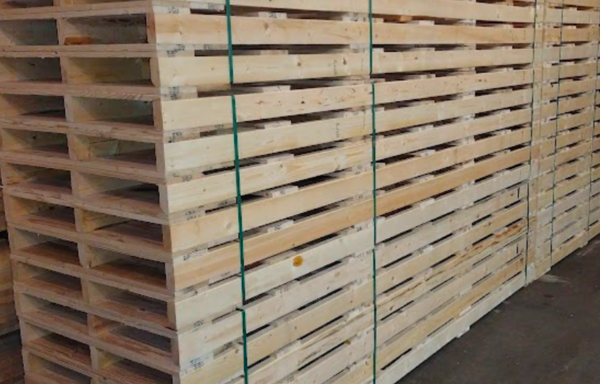
The material I choose for your custom pallet determines its weight, lifecycle, cost, and suitability for your environment. I’ve built pallets from just about every type of available softwood, hardwood and plywood. Other specialty applications include plastics and disposable corrugates and paper. Here’s how I help you decide.

Wood: The Versatile Standard
Wood remains my recommendation for the majority of custom builds—it’s renewable, repairable, and can be designed, built, and delivered in days (versus weeks of tooling for custom plastic molds).
- Softwood (Pine, Fir): Lighter weight, lower cost. I recommend softwood for one-way shipping, expendable applications, and air freight where every pound of tare weight drives up cost.
- Hardwood (Oak, Maple, Ash): Higher density, superior impact resistance. I spec hardwood for heavy-duty applications—engine blocks, steel coils, industrial machinery—where splitting or warping under extreme weight isn’t an option.
- Engineered Wood (LVL, Plywood): When I need extreme dimensional stability and moisture resistance, I use laminated veneer lumber or plywood decking. Plywood is especially useful for solid-deck pallets in pharmaceutical environments where small items can’t fall through gaps.
Plastic: For Hygiene-Critical and Wet Environments
I’m often asked whether plastic is “better” than wood. My answer: it depends entirely on your facility. High-density polyethylene (HDPE) and polypropylene (PP) pallets don’t absorb moisture, resist most chemicals, and can be sanitized with steam or chemical washes. If you’re operating a high-moisture “wet” facility, a clean-room, or a food-production line with frequent washdowns, plastic is often the smarter long-term investment.
Custom plastic pallets can also be manufactured with nestable designs that reduce empty return-shipping volume by over 60%—a huge advantage for closed-loop distribution. The trade-off is cost and lead time: custom plastic molds are expensive, and you’re typically looking at higher minimum order quantities.
For a deeper comparison of wood vs. plastic in food environments, visit our Food-Grade Pallets page.
Corrugated & Paper: The Disposable Option
For lightweight, single-use air freight where the cost of returning a pallet is prohibitive, corrugated paper pallets are an eco-friendly option. They’re 100% recyclable and pose zero pest risk—which means they don’t require ISPM-15 heat treatment for export.
Specialized Custom Pallet Designs for Irregular Loads
When standard flat platforms can’t safely support your product, I design specialized structures that cradle, secure, and protect non-standard cargo.
Cradles & Bolsters
For cylindrical objects—pipes, pumps, rolls, valves—I build wooden cradles with a U-shaped design that matches the contour of your product. This prevents rolling and shifting, which is the primary cause of transport damage for round items. For oversized flat materials like gypsum board or large metal sheets, I design bolsters that elevate the product so forklift tines can access it without damaging the cargo’s edges.
Drum Pallets
For 55-gallon drums, I design pallets with reinforced centers and dimensions—typically 48×48 or 44×44 inches—that hold four drums without overhang. These are especially critical for the chemical sector, where a single pallet failure can lead to hazardous spills and serious regulatory liability.
Top Frames for Tier-Stacked Goods
If you’re stacking glass bottles, cans, or other products that can’t bear the full compression of the tier above, I build rigid top frames that allow strapping and banding to secure the entire load to the base pallet—without crushing the top layer.
Display & Retail Pallets
When your pallet needs to look as good as the product on top of it, I build display pallets—often half-pallet sizes (24×20 inches)—with clean finishes, branded stenciling, and dimensions that fit directly into retail aisles. These “ready-to-sell” units reduce the stocking labor your retail partners need and elevate your brand’s in-store presentation.
Load Ratings Explained: Static, Dynamic & Racking
One of the most common mistakes I see is treating a pallet’s load capacity as a single number. It isn’t. A pallet has three distinct load ratings, and understanding them is the difference between a safe shipment and a warehouse incident.
|
Load Type
|
What It Measures
|
Critical Failure Mode
|
|---|---|---|
|
Static |
Max weight on a flat, level surface (floor or ground) |
Compression failure of blocks or stringers |
|
Dynamic |
Max weight while in motion (forklift transit, truck vibration) |
Shear or fastener failure during handling |
|
Racking |
Max weight when supported only at the ends (warehouse racking) |
Deflection and “creep” leading to structural collapse |
The racking load is the most demanding specification—and the one most often overlooked. When a pallet sits in a warehouse rack, it’s supported only at the ends, creating a bridge. Your product’s weight puts the center under extreme tension. Custom designs for racked environments often require reinforced center stringers or thicker deck boards to prevent the wood from bowing over time—a phenomenon engineers call “creep.” If your pallets live in racking, I engineer for that specific stress.
Dimensional Standards & Trailer Optimization
Even a “custom” pallet has to work within the real-world constraints of trailers, containers, and international shipping infrastructure. Here’s how I balance custom sizing with logistical reality.
Trailer Fit: The 48-Inch Rule
Standard North American truck trailers have a 96-inch interior width. That means two pallets fit side by side at 48 inches each. If your custom pallet is wider than 48 inches, it forces a single-row loading pattern—which can effectively double your shipping cost per unit. When a client needs a wider footprint, I always run the freight math first to make sure the total cost still makes sense.
International ISO Standards (ISO 6780)
If you’re exporting, your custom dimensions need to interface with the destination country’s logistics infrastructure. The most common international footprints are:
1200 x 800mm: The standard Euro-pallet, dominant in European supply chains.
1200 x 1000mm: Common in the UK and parts of Asia.
1165 x 1165mm: The standard in Australia.
I design custom export pallets to fit these standards with full ISPM-15 heat treatment and IPPC stamping. Visit our Heat-Treated Pallets page for a detailed breakdown of the export compliance process.
Common Custom Sizes I Build and Source
48” x 40”: The GMA industry standard — my baseline for comparison.
42” x 42”: Telecommunications and paint industries.
48” x 48”: Drums, large square products, and chemical totes (44×44 variant for drum-specific loads).
48” x 45”: Automotive parts and bulky machine components.
36” x 36”: Beverage, small-footprint applications.
24” x 20”: Half-pallets for retail display.
Fully bespoke dimensions — if your product has an unusual footprint, I design to match.
Industry-Specific Custom Pallet Solutions
Every industry has its own “logic.” Here’s how I tailor custom pallet designs to the sectors I serve most frequently.
Food & Beverage
Not every food product fits a GMA footprint. I’ve built custom 36×36 pallets for beverage companies, narrow-profile pallets for bakery rack systems, and flush-deck designs for clean-room environments. When hygiene is a factor, I build these to our Food-Grade Pallet standards — Grade A wood, contamination-free history, and optional heat treatment for mold prevention. Your custom size doesn’t mean you have to compromise on food safety.
Automotive & Heavy Industrial
The automotive sector relies heavily on 48×45-inch pallets for bulky parts and machine components. For Wisconsin’s heavy industrial sector—pumps, valves, construction equipment—I design pallets with heavy-duty hardwood stringers, larger fastener patterns, and thicker lead boards that prevent splintering when impacted by high-capacity forklifts. Many of these builds include custom-molded plastic inserts or bolt-on bolsters to secure irregular shapes.
Chemical, Paint & Hazardous Materials
The chemical sector uses specialized 44×44 or 48×42-inch pallets sized for 55-gallon drums and chemical totes. Safety drives every decision in this space—a single pallet failure can lead to environmental contamination and serious regulatory liability. I often recommend plastic for chemical environments because it doesn’t absorb residues. All designs must maintain absolute structural integrity under Wisconsin DNR and DOT hazardous transport regulations.
Export & International Logistics
International shipments often require non-standard sizes to maximize container utilization. I’ve designed Euro-compatible pallets, sea-container-optimized footprints, and export crates—all with ISPM-15 heat treatment built into the process. Every export pallet leaves our facility with a crisp, legible IPPC stamp and full documentation. Learn more on our Heat-Treated Pallets page.
Retail & Display
When the pallet is part of your in-store marketing strategy, I design display pallets with branded stenciling, clean finishes, and quarter- or half-pallet dimensions that fit retail aisles. These “ready-to-sell” units cut stocking labor and elevate brand presentation for your retail partners.
My Custom Pallet Design Process: From Specs to Your Loading Dock
I don’t start with a pallet. I start with your product. Every custom build at Logical Packaging follows this process:
I evaluate your product’s weight, dimensions, center of gravity, and stacking requirements. This is where most suppliers skip ahead—and where most pallet failures begin.
Domestic or international? Racked or floor-stacked? Food-contact or industrial? If export is involved, I build ISPM-15 compliance into the design from the start. If food safety matters, I apply our Food-Grade standards. The compliance is built in, not bolted on.
I select the optimal species, grade, and material based on your load-bearing needs, environment, and budget. New hardwood for max strength, kiln-dried softwood for lighter applications, plastic for washdown environments, or a strategic combination.
Using precision-guided manufacturing, I position every stringer, block, lead board, and deck board exactly where the stress points demand. This is engineered support, not cookie-cutter assembly.
Before any production run, I build and ship a sample for your team to test. Load it, run it through your conveyor, stack it in your trailer—then tell me it’s right.
Once approved, my team builds your order with automated consistency. Every pallet is identical to the sample. No surprises.
Beyond Pallets: Custom Crates & Skids for “Un-Packable” Items
Some products don’t just need a custom platform—they need a custom enclosure. For items that require full structural protection during transit, I design and build custom wood crates and skids with internal bracing, blocking, and cushioning engineered to absorb the specific shock and vibration profile of your shipping method. Whether it’s a delicate piece of medical equipment or a 5,000-pound industrial casting, the crate is designed around the product—not the other way around.
I also integrate pallet sleeves—twin-wall corrugated plastic systems that fit over a pallet base, transforming it into a complete modular shipping container. They protect cargo from moisture and dust while allowing irregularly shaped items to be stacked and strapped securely.
The ROI of Going Custom
Custom pallets carry a modest per-unit premium over standard sizes. But in my experience, the “true cost” almost always favors custom when you look at the full picture.
|
Cost Factor
|
Custom Pallet Impact
|
Financial Result
|
|---|---|---|
|
Freight Volume |
More units per trailer through precise sizing |
Lower cost per shipped unit |
|
Product Damage |
Significant reduction through fit-for-purpose support |
Fewer returns, rework, and insurance claims |
|
Labor |
Reduced re-palletizing and manual adjustments |
Higher warehouse throughput |
|
Asset Life |
Higher durability for specific loads |
Lower annual pallet procurement spend |
|
Compliance |
Built-in ISPM-15 or food-grade standards |
Avoidance of fines and shipment rejections |
I’ve seen a beverage distributor increase palletized loads per trailer from 24 to 30 simply by switching from a standard GMA pallet to a custom block design. That’s six more loads per truck, compounding into significant annual freight savings. I help every client run this total-cost analysis before they commit—because the logical answer is never just the line-item price.
Let’s Design Your Custom Pallet Solution
The wrong pallet size isn’t just an inconvenience—it’s a hidden cost that compounds with every shipment. I’ve helped hundreds of businesses eliminate product damage, optimize trailer space, and streamline automation lines with purpose-built custom pallets and crates. If you’re tired of making standard pallets “work” for non-standard products, I’d like to show you a more logical approach. Fill out the quote request form below with your dimensions and load requirements, and I will personally review your specifications to design the most cost-effective solution for your operation.